
DALI dimming represents the global open standard for intelligent, digital lighting control designed to deliver flicker-free brightness adjustment, individual fixture addressability. Coordinating a large-scale commercial lighting setup often becomes an electrical nightmare, riddled with rigid physical wiring layouts, complex grouping limitations, and high installation costs.
Project engineers and building designers are frequently forced to settle for outdated analog controls that suffer from significant voltage drops, erratic flickering, and zero status monitoring. Fortunately, standardizing your commercial developments on a digital, software-defined control framework eliminates these bottlenecks entirely, turning complicated physical wiring into a programmatically managed network of smart luminaires.
What is the technical basis of DALI dimming?
The technical basis of DALI dimming is an open, international digital communication protocol governed by the IEC 62386 standard that enables bidirectional, addressable control of individual lighting ballasts. By adopting this digital standard in your commercial developments, you establish a decentralized network where every light source communicates bidirectionally.
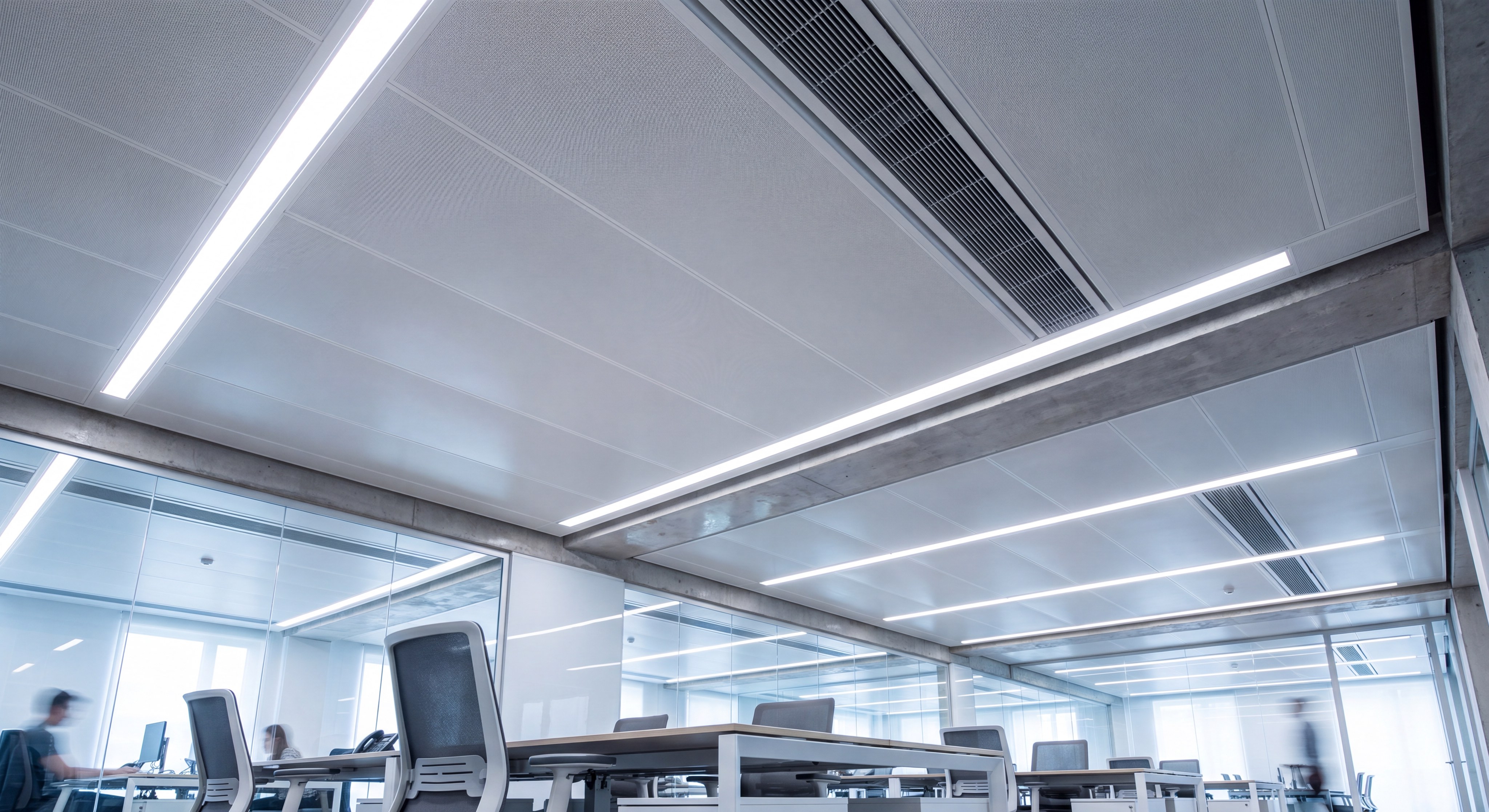
What does the DALI acronym stand for?
Think about it:
The acronym stands for Digital Addressable Lighting Interface, representing a non-proprietary system that ensures universal brand interoperability. This global standard allows components from completely different manufacturers to communicate flawlessly on the same network.
- Open Standard: Governed by the international IEC 62386 specification.
- Bidirectional Control: Enables both command transmission and status reporting.
The evolution of digital lighting control
Here is the deal:
Digital lighting control evolved as a robust answer to traditional analog protocols that were highly susceptible to electrical interference. Early digital solutions lacked addressability, leading directly to the creation of the more advanced DALI-2 certification standard.
- Analog Legacy: Unidirectional and highly susceptible to voltage drop.
- DALI-2 Standard: Strict interoperability verification managed by the DiiA alliance.
How does the interface send and receive data?
Why does this matter?
The system transmits digital command frames across a two-wire bus line using Manchester encoding to prevent communication drops. Operating at a stable nominal voltage of 16V DC, the bus allows controllers and drivers to share telemetry without interference.
- Safe Voltage Range: Standard operating range of 12V to 20.5V DC.
- Bus Current Limit: Strictly capped at 250mA per loop line to ensure safety.
Key Takeaway: Understanding the foundational digital protocol of this interface ensures that you specify highly robust systems that are fundamentally immune to noise and designed for long-term commercial deployments.
| Parameter | Value | B2B Relevance |
|---|---|---|
| Protocol Standard | IEC 62386 | Brand-agnostic interoperability |
| Bus Signal Voltage | 16V DC Nominal | Safe, low-voltage control lines |
| Maximum Bus Current | 250mA | Prevents electrical system overload |
Adhering to these basic electrical parameters enables electrical engineers to layout stable, high-performance digital lighting zones.
Why should you choose DALI dimming for projects?
You should choose DALI dimming for your commercial projects because it provides immense design flexibility, drastically lowers installation labor costs, and guarantees hardware compatibility across brands. This digital approach future-proofs your properties from the day of commissioning by simplifying post-installation adjustments.

Maximum flexibility in lighting design
Look:
Software-driven zoning allows you to completely alter lighting circuits and groupings without altering the physical copper wires. This adaptive capacity is vital for modern commercial offices and agile retail environments.
- Virtual Zoning: Group fixtures digitally without accessing ceiling panels.
- Scene Presets: Store up to 16 custom scenes directly in driver memory.
How does it reduce installation complexity?
But that is not all.
The installation utilizes a simple two-wire bus that can run in the exact same conduit as the mains power lines without shielding. This polarity-free layout drastically reduces the risk of onsite wiring mistakes during commission.
- Polarity-Free Design: Eliminates the risk of backward-wired signal lines.
- Shared Conduits: Run power and control cables together safely.
Standardized compatibility across brands
Think about it:
Adopting an open international protocol protects your commercial project from vendor lock-in. Any DALI-2 certified driver will integrate perfectly with certified controllers regardless of the supplier.
- Certified Integrity: Guaranteed compliance via official DiiA certification testing.
- Future-Proofing: Effortlessly replace older hardware with new certified models.
Key Takeaway: Selecting an open-standard digital control system safeguards your initial capital investments by ensuring long-term hardware availability and significantly lower operational overheads.
| Benefit Category | Practical B2B Application | Key Advantage |
|---|---|---|
| Design Flexibility | Commercial offices and retail displays | Virtual regrouping without re-wiring |
| Installation Efficiency | High-rise buildings & hotel developments | Polarity-free, non-shielded cabling |
| Interoperability | Complex commercial retrofits | Mix-and-match certified brand parts |
These fundamental B2B advantages directly translate to shorter construction timelines and reduced contingency budgets for contractors.
How do you control DALI dimming setups?
You control DALI dimming layouts through an intelligent master controller that transmits digital commands to addressable slave drivers over a low-voltage bus. Managing industrial or office illumination is simple once you integrate these master units to coordinate automated schedules and occupancy sensors.
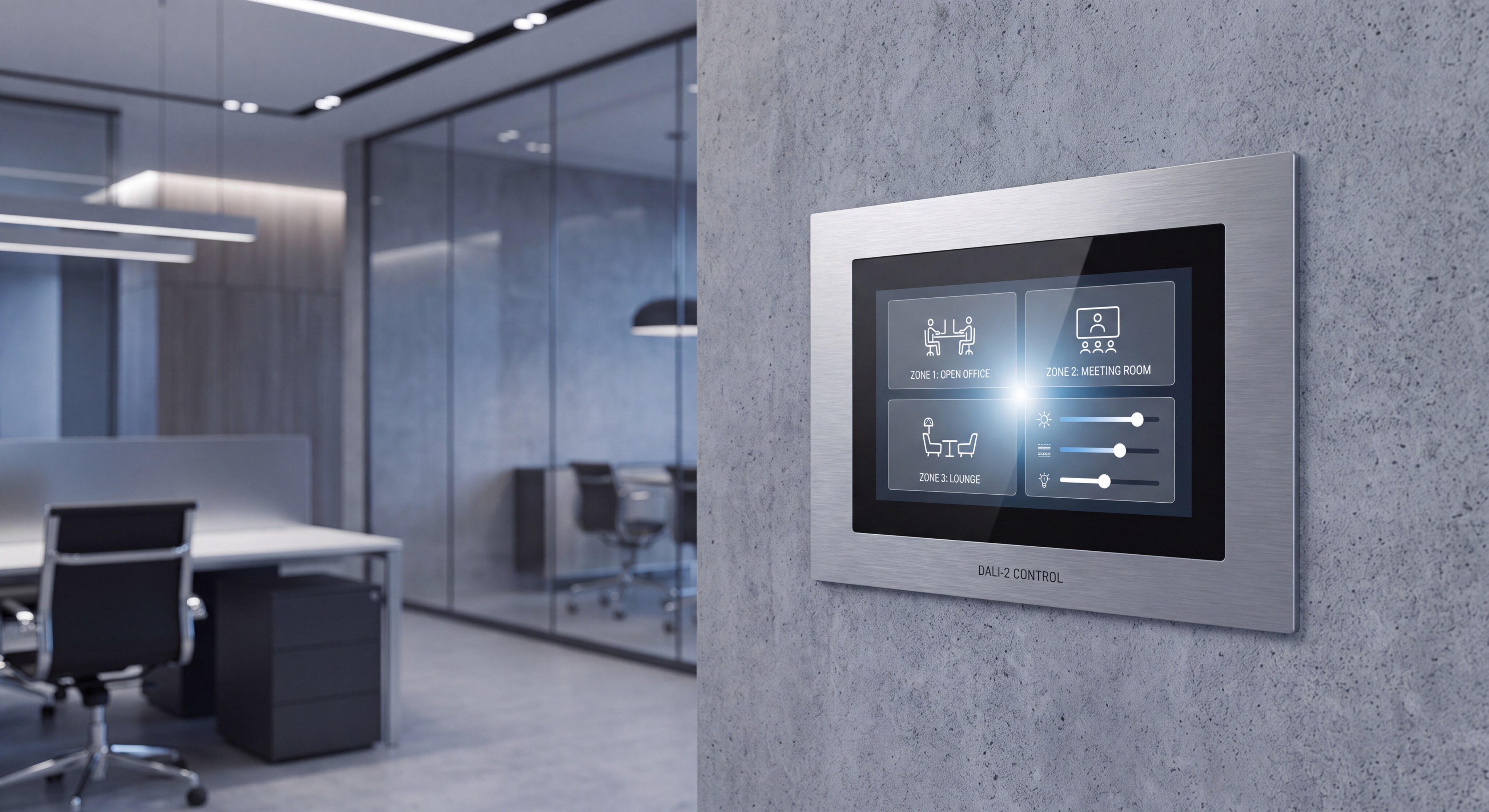
Understanding the role of the master controller
Here is the deal:
The master controller serves as the central brain, converting user commands from panels or touchscreens into standardized digital frames. It manages overall schedules, automates brightness levels, and integrates environmental sensors.
- Automated Scheduling: Adjust lights based on business hours.
- Sensor Integration: Seamlessly connect motion and light detectors.
What is the function of the DALI bus?
Why does this matter?
The two-wire bus acts as the digital pathway carrying low-voltage command signals to all drivers and sensors. It requires a dedicated localized power supply to ensure smooth communication frames.
- High Bus Capacity: Support up to 64 short addresses per individual loop.
- Low-Voltage Pathway: Safely carries the 16V nominal digital signal.
Grouping and zoning without physical re-wiring
The reality is:
You can partition lights into 16 unique zones and program 16 specific scenes purely using software tools. Because each driver saves its grouping settings locally, execution is incredibly fast and bus traffic is minimal.
- Local Memory: Drivers instantly execute locally saved scenes.
- System Scalability: Bridge multiple loops via gateways to manage thousands of lights.
Key Takeaway: Using a software-defined digital control network allows for extreme granular zoning that minimizes long-term configuration and commissioning labor.
| Component | Role in Network | Technical Specification |
|---|---|---|
| Master Controller | Main processor and decision engine | Fully programmable by software |
| DALI Bus | Bidirectional communication path | Polarity-free, up to 300m length |
| Bus Power Supply | Low-voltage signal energization | 16V DC nominal, max 250mA |
Comprehending these key components allows engineering teams to design highly reactive and energy-efficient building layouts.
How does 0-10V compare to DALI dimming?
The primary difference is that 0-10V is an outdated, unidirectional analog system while DALI dimming is a modern, bidirectional digital standard configured via software. Selecting this digital standard for complex building plans resolves traditional analog layout issues like signal degradation and limited zoning control.

The fundamental differences in signal types
Think about it:
Analog systems depend on changing physical voltages, making them highly vulnerable to signal drops over long cable runs. Digital communication uses binary data packets that stay perfectly consistent from the master controller to the furthest driver.
- Digital Packets: Command signals remain 100% consistent across long lines.
- No Signal Drop: Prevents mismatched brightness levels in large spaces.
Why is DALI dimming more precise than 1-10V?
Look:
The digital system features a standardized logarithmic curve designed specifically to match the natural light perception of the human eye. This guarantees identical dimming performance across various fixture manufacturers, which analog systems cannot provide.
- Eye-Matched Curves: Standardized logarithmic performance across all brands.
- Stable Low-Level Dimming: Achieve flicker-free control down to 0.1% or 1%.
Comparing scalability and system feedback
But that is not all.
Digital loops provide instant diagnostic feedback, alerting facility managers of exact fixture failures or ballast errors immediately. Analog setups are completely blind, requiring manual visual inspections to find a dead lamp.
- Full Diagnostics: Remotely identify exact bulb and driver failures.
- Fewer Wires: Run a single shared bus instead of massive separate wire loops.
Key Takeaway: Selecting a digital addressable system over analog lines dramatically lowers ongoing operational costs while providing a highly polished visual experience.
| Technical Parameter | Legacy 0-10V / 1-10V Analog | Digital DALI Dimming |
|---|---|---|
| Signal Method | Analog voltage variation (0-10V) | Bidirectional digital data frames |
| Zoning Setup | Physical copper hardwiring | Flexible virtual software zoning |
| System Diagnostics | None (unidirectional output only) | Real-time fixture and ballast status |
Transitioning to digital infrastructure resolves the core maintenance and performance limitations inherent in legacy systems.
What are DT6 and DT8 types of DALI dimming?
DT6 devices are dedicated single-channel drivers used to control basic light intensity, whereas DT8 devices use multi-channel controllers to manage color temperature and color-changing outputs on a single address. Understanding how DALI dimming operates within these distinct Device Types is critical when designing spaces that require color-tuning or dynamic atmospheres.
What is the focus of a DT6 device?
Here is the deal:
Device Type 6 focuses exclusively on controlling standard light intensity of static, single-color fixtures. If your project includes dynamic multi-color LEDs, DT6 requires you to allocate a separate short address for each color channel.
- Single-Color Focus: Best suited for standard, static white illumination.
- Address Exhaustion: Consumes three of your sixty-four available addresses for one RGB setup.
How does DT8 manage color temperature?
Why does this matter?
Device Type 8 utilizes advanced internal color-mixing logic to manage CCT, RGB, and RGBW parameters through one single address. The complex color processing occurs directly inside the driver itself rather than overwhelming the central master bus.
- Single-Address Tuning: Handle complex color schemes with one address slot.
- Advanced Modes: Native support for Tunable White and RGBW systems.
Key differences in address requirements
The reality is:
Utilizing DT8 is highly recommended for modern tunable lighting because it conserves your restricted 64-address capacity. This allows you to fit many more complex fixtures on a single physical control loop.
- Address Preservation: Drastically increases the maximum fixture count per loop.
- Simpler Cabling: Minimizes the physical driver and controller count.
Key Takeaway: Specifying DT8-compliant drivers is the most efficient and cost-effective approach to deploying modern tunable white and color-changing LED strip configurations.
| Specification | Intended Application | Addressing Efficiency | Primary Features |
|---|---|---|---|
| Device Type 6 (DT6) | Static single-color lighting | 1 Address per channel | Basic dimming, industry standard |
| Device Type 8 (DT8) | Tunable White, RGB, RGBW | 1 Address for multiple outputs | Integrated color and CCT tuning |
Harnessing DT8 technology allows project specifiers to deliver complex color environments without complicating system architecture.
How does KNX automation compare to DALI dimming?
KNX is a comprehensive whole-building automation system that coordinates multiple utilities, while DALI dimming is a specialized, high-precision subsystem focused entirely on professional lighting control. Standardizing your project on this dedicated lighting framework allows you to build a highly optimized building architecture.

Understanding protocol roles in building management
Think about it:
A Building Management System (BMS) like KNX manages everything from heating to safety shutters, but it lacks the granular, cost-effective capabilities needed for complex lighting. Dedicated subsystems are required to handle dynamic, addressable light fixtures efficiently.
- BMS Scope: Direct management of HVAC, security, and smart meters.
- LSS Scope: Built specifically for micro-precision lighting and sensor networks.
How do BACnet and LON differ from DALI?
Look:
Industrial networks like BACnet and LON excel at high-level building scheduling but do not support specialized lighting variables like fade times or logarithmic curves. Implementing them directly to control individual LED chips is extremely inefficient and cost-prohibitive.
- Macro Scheduling: BACnet manages facility-wide time clocks.
- No Native Dimming: Lacks the specialized resolution required for smooth dimming steps.
Integrating gateways to bridge LSS and BMS
But that is not all.
By integrating certified KNX-to-DALI or BACnet-to-DALI gateways, you can bridge these building protocols perfectly. For example, swiping an access card at the main door can signal the gateway to trigger a welcoming lobby light scene.
- Seamless Bridges: Connect main automation networks with specialized light loops.
- Smart Triggers: Activate specific lighting scenes based on occupancy or alarms.
Key Takeaway: Integrating specialized lighting loops with a master building management system via certified gateways delivers maximum operational efficiency and unparalleled control granularity.
| System Type | Primary Focus | Control Resolution | Typical Use Case |
|---|---|---|---|
| DALI / DALI-2 | Lighting and sensors | High-precision micro-commands | Dynamic offices, retail showrooms |
| KNX Protocol | Full-building automation | Broad system coordination | Integrating blinds, climate, gateways |
| BACnet / LON | Large-scale facilities | Macro-level monitoring | University and hospital facility management |
Utilizing a hybrid approach with specialized gateways provides a robust control infrastructure that meets both macro and micro needs.
How is wiring configured for DALI dimming?
The wiring for DALI dimming consists of a simple, polarity-free two-wire bus that connects master controllers and slave devices in star, tree, line, or mixed layouts. Ensuring your control cables are sized and routed correctly prevents data collisions and signal reflections.

Master-slave architecture explained
Here is the deal:
A central application controller acts as the transmitter, distributing commands to addressable slave LED drivers at a stable baud rate of 1200 bps. This bidirectional, half-duplex speed is intentionally slow to ensure maximum signal integrity over long distances.
- Bidirectional Flow: Drivers report real-time ballast performance data.
- Robust Communication: Slow baud rates resist interference across extensive networks.
Why is special shielding not required?
Why does this matter?
The digital signal operates with high voltage tolerances, making it highly immune to electromagnetic interference. Consequently, you can safely run the two control lines inside the same multi-core power sheath as your AC mains.
- High Noise Immunity: Resists interference from neighboring power lines.
- Saves Conduit Space: Run mains power and control signals together.
Wiring topology options
The reality is:
You can arrange your control lines using star, tree, line, or mixed topologies to suit your building design. However, you must avoid loop or closed-ring wiring paths, as they will cause severe communication failures.
- Allowed Layouts: Extreme flexibility with star, tree, and daisy-chain paths.
- Prohibited Rings: Closed loops prevent digital packets from routing correctly.
Key Takeaway: Utilizing a highly flexible, polarity-free, non-shielded control wiring layout saves B2B contractors massive installation labor and material expenses.
| Wire Cross-Section | Max Cable Distance | Supported Topologies | Core Restrictions |
|---|---|---|---|
| 0.5 mm² | Up to 100 meters | Star, Tree, Line, Mixed | Strictly no closed loops/rings |
| 0.75 mm² | Up to 150 meters | Star, Tree, Line, Mixed | Strictly no closed loops/rings |
| 1.5 mm² | Up to 300 meters | Star, Tree, Line, Mixed | Strictly no closed loops/rings |
Adhering to these cable specifications ensures error-free digital communication across your entire lighting layout.
What is the default curve style of DALI dimming?
The default curve style of DALI dimming is a standardized logarithmic scale that perfectly aligns with the physiological perception of the human eye. This ensures that when configuring these digital systems, visual transitions in brightness feel incredibly natural and consistent to occupants.
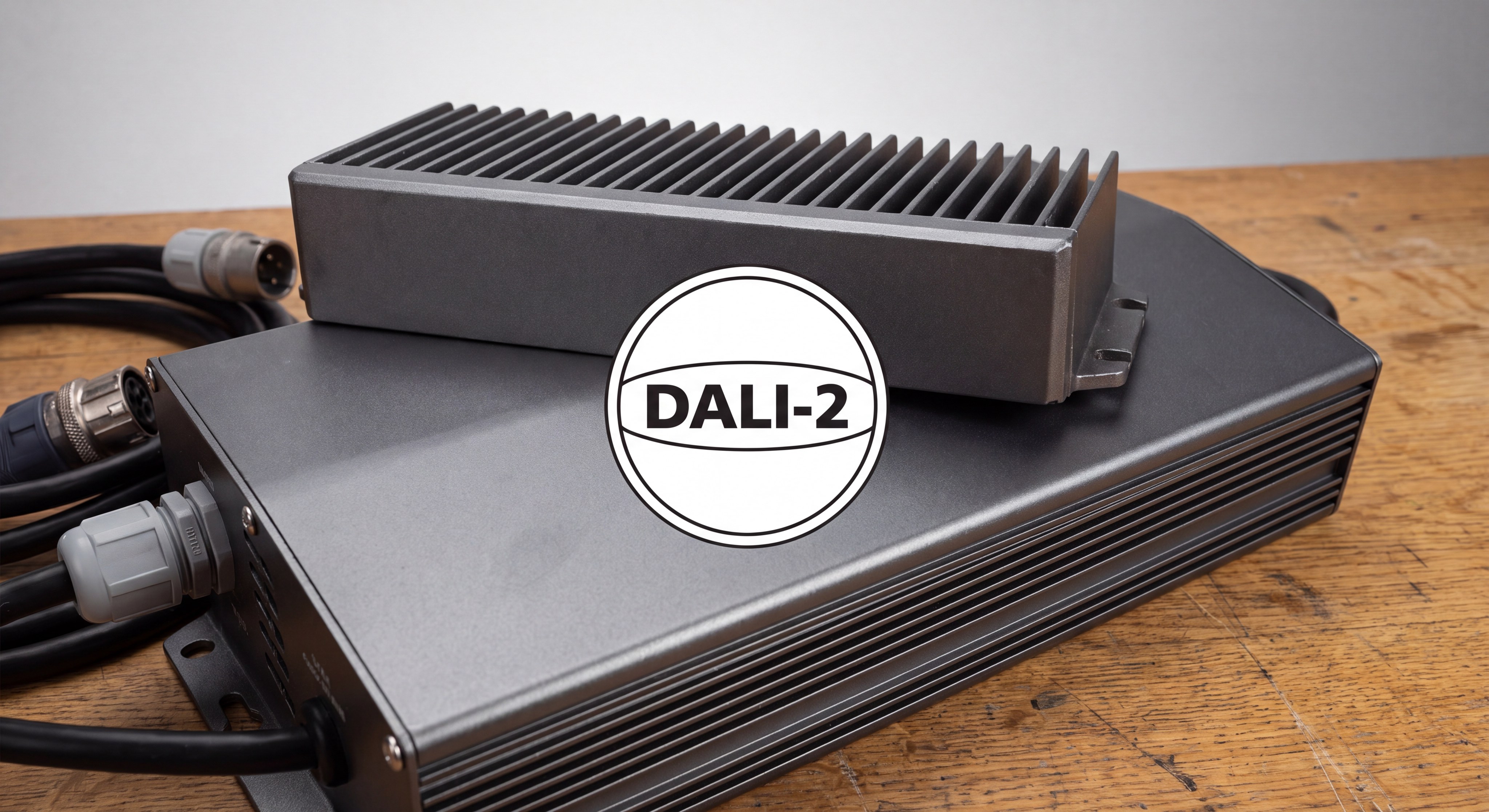
Logarithmic versus linear dimming curves
Think about it:
The logarithmic standard is ideal for general architectural spaces, but most drivers can be reprogrammed to use a linear curve when necessary. Linear configurations are typically chosen for scientific labs or sensor calibration setups.
- Logarithmic Default: Standard curve optimized for human vision.
- Linear Curve Option: Best for industrial testing or lux sensor integration.
How does human eye perception affect dimming?
Look:
Human eyes are incredibly sensitive to changes in low light, meaning a light measured at 1% actual power feels like 10% brightness to us. To create an environment that feels truly dim, you must select high-quality drivers that can handle extreme low-level outputs.
- Perceived Brightness: Light levels feel much brighter than measured power suggests.
- High-End Projects: Requires drivers capable of deep, stable low-level outputs.
Achieving true dim-to-dark performance
But that is not all.
True dim-to-dark performance means reducing light output smoothly down to 0.1% or lower before turning the circuit completely off. Premium digital drivers achieve this transition without any sudden visual dropout or “pop-on” issues.
- 0.1% Threshold: Indispensable for luxury hotels, theaters, and premium boardrooms.
- No Flickering: High-quality digital control ensures stable, flicker-free transitions.
Key Takeaway: Specifying digital drivers with true logarithmic dimming and ultra-low dim-to-dark capabilities is crucial for delivering exceptional visual comfort and premium project value.
| Measured Light Level | Perceived Brightness | Ideal Architectural Space |
|---|---|---|
| 100% | 100% | General offices, commercial retail |
| 10% | ~32% | Corridors, lobbies, public spaces |
| 1% | ~10% | Restaurants, ambient spaces, lounges |
| 0.1% | ~3% | Luxury hotel suites, high-end theaters |
Designing with these perceptual differences in mind is the secret to creating world-class lighting experiences.
How can you succeed with DALI dimming setups?
You can succeed with DALI dimming by conducting a detailed ROI analysis, addressing setup challenges early, and partnering with a premium OEM manufacturer. Implementing this digital system in your commercial real estate developments boosts market valuation and simplifies long-term energy code compliance.

Analyzing the key advantages for B2B projects
Here is the deal:
Integrating a digital control network significantly reduces ongoing building maintenance costs through automatic lamp fault detection and power tracking. It also helps your developments earn points toward sustainability certifications.
- Energy Management: Track power usage in real-time.
- Green Standards: Earn valuable credits for LEED or WELL certifications.
What are the potential implementation challenges?
Why does this matter?
Digital networks carry a higher initial hardware cost and require software configuration compared to basic analog systems. However, pre-addressing your drivers during manufacturing can dramatically reduce onsite commissioning labor.
- Upfront Investment: Higher initial cost for certified hardware.
- Commissioning Phase: Demands software setup and address verification.
Partnering with the right OEM manufacturer
The reality is:
Working with a highly experienced manufacturing partner ensures your high-end project is executed flawlessly without technical issues. Darkless LED offers over 20 years of production expertise, providing premium OEM-customized LED strip lights and pre-configured drivers to streamline your installation. When you want your commercial builds to perform with certified, flicker-free perfection, please contact us to discuss your technical specifications.
- 20+ Years of Experience: Deep expertise in high-CRI and customized linear LEDs.
- Pre-Configured Systems: We source, program, and validate compatible drivers.
Key Takeaway: Partnering with an established manufacturing leader secures your supply chain, slashes onsite programming times, and eliminates post-installation issues.
| Project Challenge | Strategic OEM Solution | B2B Return on Investment |
|---|---|---|
| High Upfront Costs | Buy direct from an established OEM | Lower maintenance and energy costs |
| Complex Commissioning | Pre-address drivers during production | Faster handovers and lower onsite labor |
| Skilled Labor Deficit | Deploy pre-tested plug-and-play kits | Lower error rates and faster installations |
Partnering with Darkless LED bridges the gap between hardware procurement and seamless, trouble-free deployment.
Conclusion
Standardizing your next commercial project on a digital lighting network is the single most effective way to eliminate electrical installation bottlenecks, lower long-term maintenance costs, and provide a world-class visual experience. By choosing a flexible, software-configured architecture, you future-proof your facility and ensure it easily adapts to changing tenant needs.
To achieve these goals, partnering with an experienced manufacturer like Darkless LED gives you access to premium, custom-engineered lighting systems and certified drivers backed by over two decades of production mastery. When you are ready to elevate your commercial buildings with robust, flicker-free, and energy-efficient illumination, contact us today to schedule a professional technical consultation.
FAQ
Can I run DALI control lines with mains power?
Yes, you can run them together without issues. Because the protocol utilizes highly robust digital signal levels, the two control wires can safely run inside the same multi-core cable sheath as the AC mains power lines without any risk of electromagnetic interference or the need for special shielding.
What is the best driver for my LED strip lights?
The best choice is a dedicated DALI-2 certified driver with a wattage rating at least 10% to 20% higher than the maximum power consumption of your linear strip. For dynamic installations, choosing a Device Type 8 (DT8) driver is highly recommended as it allows color and CCT tuning over a single network address.
How many fixtures can I connect to a single bus?
A standard single DALI bus line can support up to 64 individual short addresses for control gear (drivers) and an additional 64 addresses for control devices (sensors and switches). If your project requires more fixtures, you can easily link multiple independent bus loops together using gateways connected to a master controller.
Can I convert an existing 0-10V system to a digital DALI network?
Yes, you can retroactively convert an analog 0-10V system by replacing the legacy analog drivers with addressable digital drivers and installing a master controller. However, you will need to run the two-wire digital bus to all fixtures, so planning this during a major renovation is the most cost-effective path.
What is the main difference between DALI and DSI systems?
Although both are digital lighting control systems, DSI is a proprietary, unidirectional protocol where all connected fixtures respond together as a single group. The DALI protocol is an open, bidirectional international standard that allows each individual fixture to be addressed, grouped, and monitored independently.