
COB LED strip lights are advanced lighting modules where multiple LED chips are bonded directly to a flexible substrate and covered by a shared phosphor coating to create a seamless line of light. You might find that traditional lighting often creates distracting “hot spots” or visible dots that ruin the sleek look of your architectural designs.
This fragmented light is particularly agitating when it reflects off polished marble, glass, or stainless steel, making even the most expensive installations look unrefined and uneven. The professional solution is the COB LED Strip, which utilizes high-density chip technology to provide a perfectly uniform, dotless glow for any high-end B2B application.
What Exactly Is a COB LED Strip?
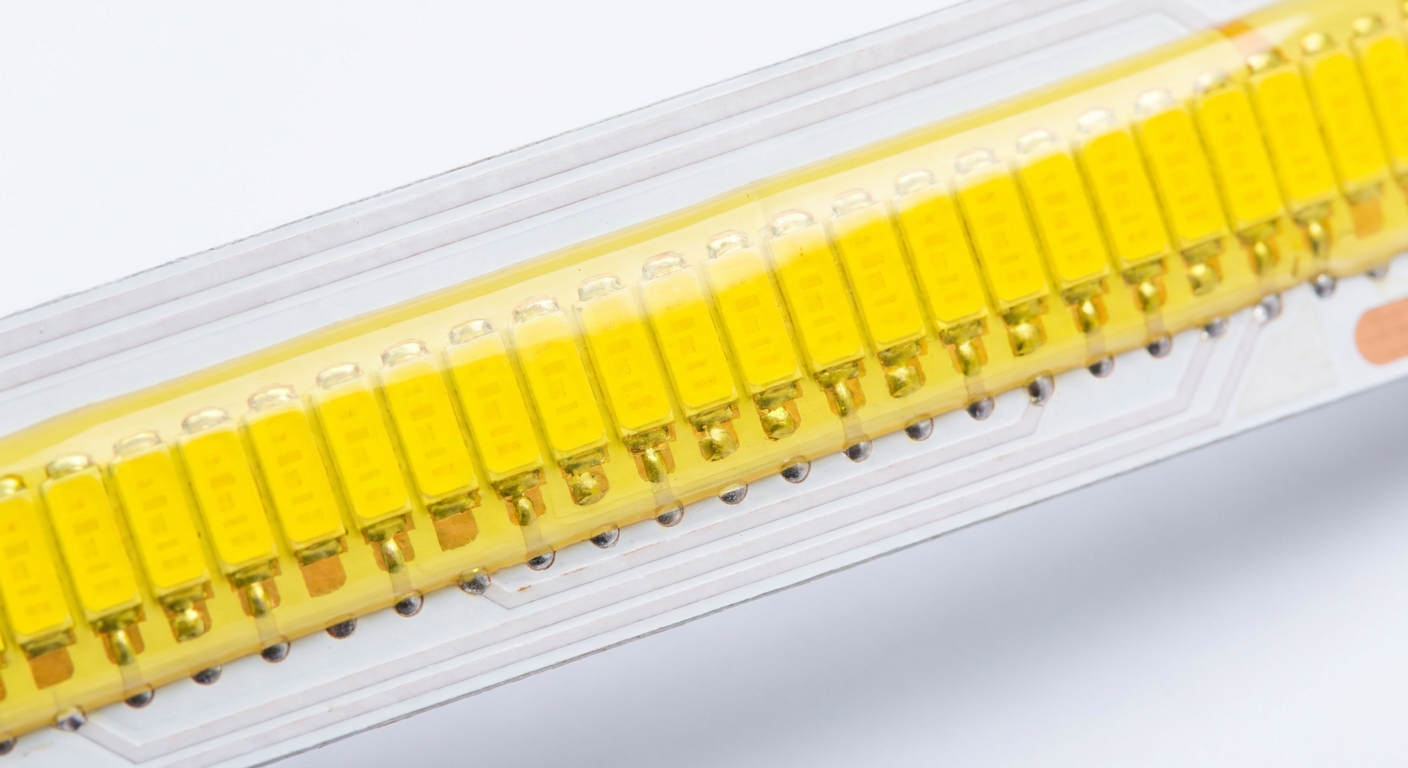
A COB LED strip is a high-density illumination source that mounts dozens of tiny LED chips directly onto a circuit board under a continuous phosphor gel. This specific construction allows the COB LED strip to emit a solid beam of light that mimics the look of traditional neon tubes without the bulk. By removing the bulky plastic packaging found in older models, you can achieve a much thinner and more flexible lighting profile for your projects.
How are the diodes arranged?
Think about it: the closer the chips, the smoother the light. In this technology, manufacturers place hundreds of diodes per meter to ensure there is virtually zero gap between light sources. You will notice that this dense arrangement is what prevents the “speckled” look common in lower-quality lighting.
- High chip count (often 320 to 512+ per meter).
- Direct bonding to the flexible PCB.
- Minimal spacing between individual light-emitting points.
What is the role of the phosphor coating?
But there is more. The yellow-orange phosphor layer acts as a single, massive lens that blends the light from every chip into one coherent output. When you power the strip, this coating converts the blue light from the chips into the specific white or colored temperature you require.
Key Takeaway: COB (Chip on Board) technology uses ultra-dense chip placement and a shared phosphor layer to eliminate the space between diodes.
| Component | Primary Function |
|---|---|
| Micro Chips | Provide the raw light output at high density. |
| Phosphor Gel | Diffuses light and determines color temperature. |
| Flexible PCB | Carries current and manages initial heat dissipation. |
This integration of components ensures that you receive a solid line of light regardless of the viewing angle.
How Does a COB LED Strip Differ From SMD?
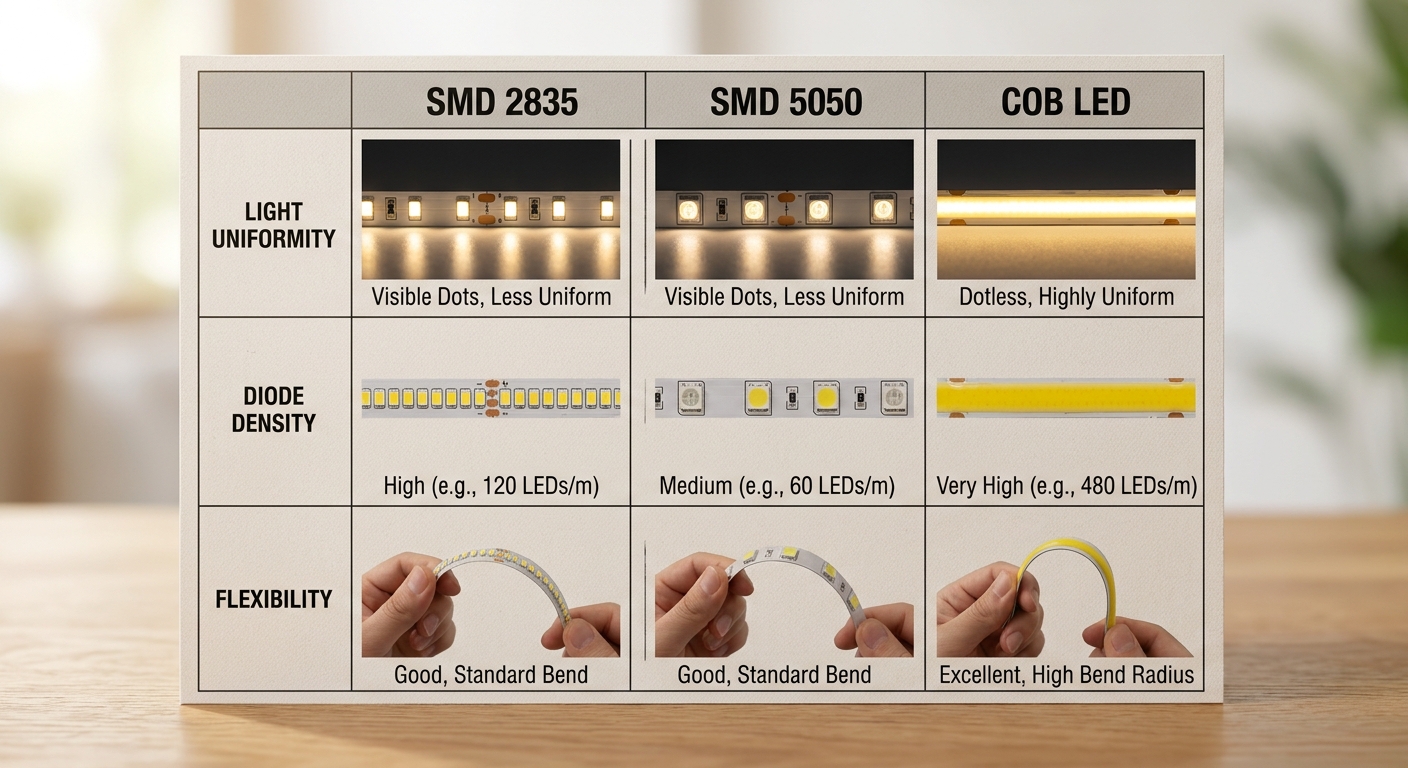
The main difference between these technologies is that COB strips offer a continuous glow, while SMD strips feature distinct, separated diodes. Choosing a COB LED Strip ensures your installation avoids the “ladder effect” where light appears in chunks rather than a smooth wash. While SMD technology is still useful for indirect lighting in deep coves, COB is the superior choice for visible or reflective surfaces.
What about light density comparisons?
Here is the kicker: density determines quality. While a standard SMD strip might have 30 or 60 LEDs per meter, a COB version typically starts at 320 LEDs per meter. You can easily see how this massive increase in light points creates a more premium aesthetic for your clients.
- SMD: 30–120 diodes per meter.
- COB: 320–500+ diodes per meter.
- Result: COB provides 5x to 10x the light points for better uniformity.
Is the flexibility of COB superior?
You might be wondering about durability. Because the chips in a COB layout are much smaller and lack heavy individual packaging, the strip can bend at much tighter radii. This allows you to wrap the lighting around sharp corners or tight circular fixtures without damaging the circuit.
Key Takeaway: COB strips provide significantly higher diode density and better flexibility than SMD strips, making them ideal for complex architectural shapes.
| Feature | SMD Strip | COB Strip |
|---|---|---|
| Visual Texture | Pixelated / Dotted | Seamless / Dotless |
| Flexibility | Moderate (Standard) | High (Tight Bends) |
| Light Angle | ~120 Degrees | ~180 Degrees |
The wider beam angle of COB helps you achieve better light coverage in narrow spaces.
Why Is COB LED Strip Lighting Dotless?
A COB LED strip is dotless because the individual light sources are so close together that their outputs overlap before the light even leaves the phosphor coating. When you use a COB LED strip, you are essentially using a single long, linear light source rather than a string of individual bulbs. This is the secret to achieving that high-end, architectural look in modern interior design projects.
How does it eliminate hot spots?
Think about it: dots only appear when there is a dark gap between light sources. By placing the chips effectively side-by-side, the dark spots are completely removed. You can place these strips directly against a wall or under a cabinet, and you will see a smooth gradient of light instead of jagged patterns.
- Overlapping light paths within the phosphor layer.
- No “dead zones” between the high-density chips.
- Continuous encapsulation of the entire circuit.
Why does it look like a neon tube?
But there is more. The phosphor coating acts as a built-in diffuser, so you do not always need a thick, frosted lens to hide the diodes. This allows you to use slimmer aluminum profiles while still maintaining a perfectly uniform appearance that mimics the glow of expensive neon signage.
Key Takeaway: The “dotless” effect is a result of ultra-tight chip spacing combined with a shared diffusing layer that blends individual light beams.
| Problem | COB Technical Solution |
|---|---|
| Harsh Shadows | Uniform linear output creates soft, even shadows. |
| Reflective Glare | Smooth phosphor layer prevents “spotty” reflections on stone. |
| Visual Noise | Continuous glow reduces eye strain in direct-view apps. |
Eliminating visual noise allows your lighting to blend into the architecture rather than distracting from it.
Where Can You Use a COB LED Strip?
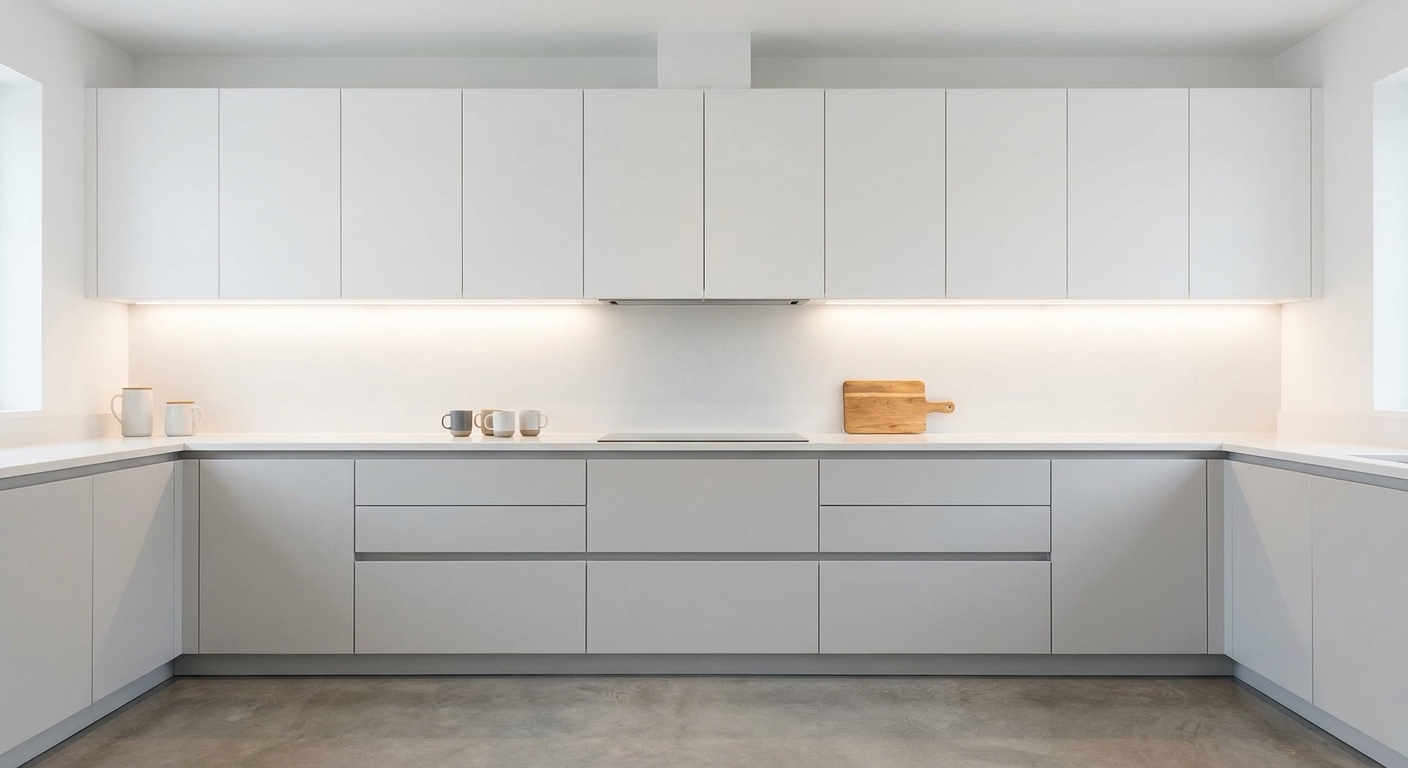
You can use a COB LED Strip in any application where the light source is visible or reflected off a shiny surface. These strips are the gold standard for high-end residential and commercial projects because they provide a clean, professional finish. Whether you are lighting a hotel lobby or a retail jewelry case, the LED Strip Light technology ensures every detail is illuminated perfectly.
Is it best for under-cabinet lighting?
Here is the kicker: your kitchen counters are likely reflective. If you use standard LEDs, you will see a line of dots reflected on your granite or quartz surfaces. By switching to COB, you ensure that the reflection is a single, clean line of light that enhances the premium feel of the space.
- Under-cabinets for task lighting.
- Toe kicks for a floating floor effect.
- Cove lighting for a soft ceiling wash.
Can it be used in jewelry displays?
Think about it: jewelry needs to sparkle without being overwhelmed by harsh, uneven light. You can use high-CRI COB strips to make gold and diamonds pop while maintaining a neutral, uniform background. This consistency helps you create a luxurious atmosphere that encourages sales and improves the customer experience.
Key Takeaway: COB strips are designed for “close-up” applications where the strip or its reflection would normally reveal individual diodes.
| Application | Why COB is Required |
|---|---|
| Hospitality | Creates a high-end, luxurious feel in guest rooms. |
| Retail Displays | Provides uniform light that doesn’t distract from products. |
| Exhibition Stands | Lightweight and flexible for custom booth designs. |
Using COB in retail settings can significantly improve the perceived value of the merchandise on display.
Is a COB LED Strip Easy to Customize?
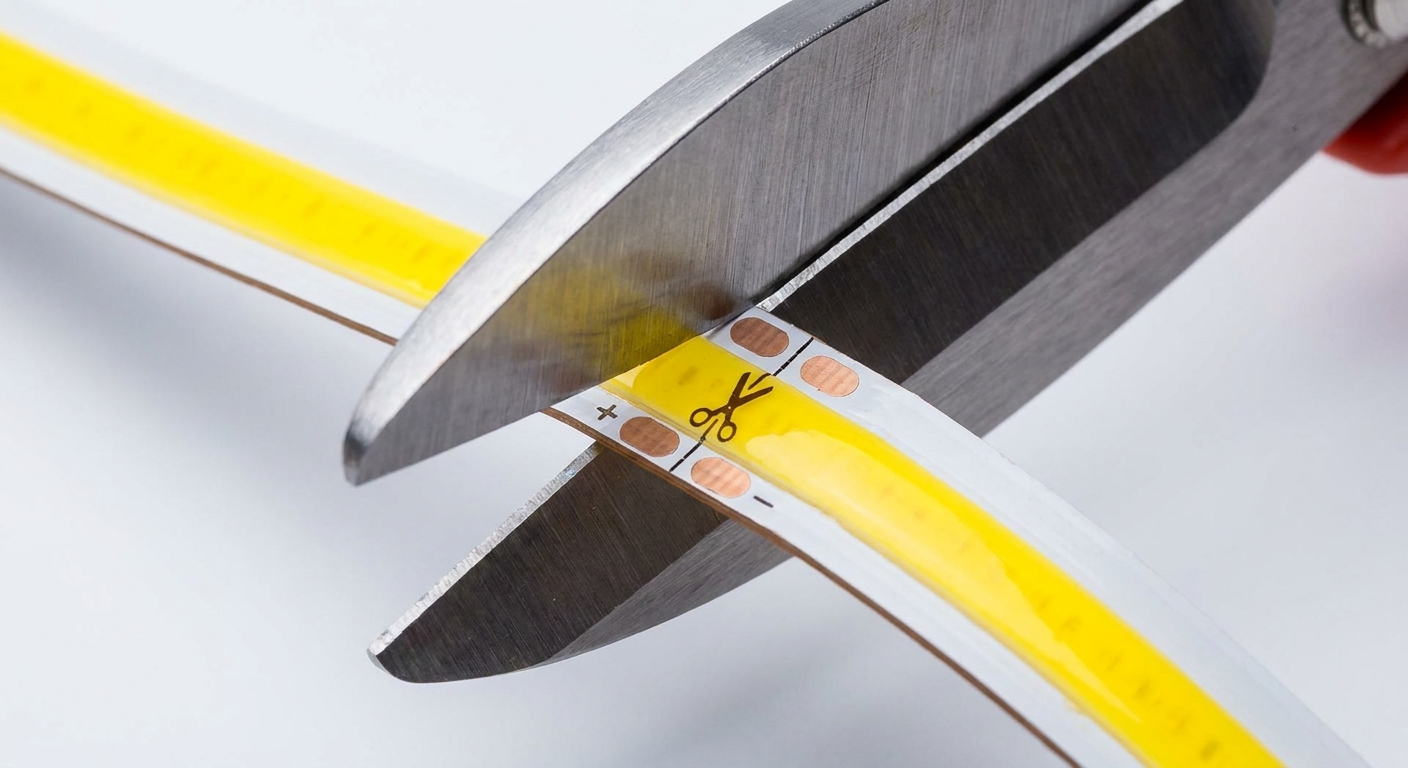
Yes, a COB LED strip can be easily cut, extended, and shaped to fit the exact dimensions of your project. You simply need to follow the designated cut marks to ensure the internal circuitry remains intact. This high level of customization makes the COB LED strip one of the most versatile tools for professional installers and lighting designers.
Where can you cut the strip?
But there is more. You must look for the copper pads or scissor icons printed on the back or side of the strip. These marks indicate the safe zones where you can divide the strip without breaking the electrical path for the rest of the reel.
- Identify the copper soldering pads.
- Use sharp shears to make a clean, straight cut.
- Ensure you only cut while the power is disconnected.
How do you connect different segments?
Think about it: you don’t always need to be a master at soldering. You can use solderless clip-on connectors specifically designed for the width of your strip to join two pieces together. This allows you to create long runs or navigate around obstacles like corners and shelving with ease.
Key Takeaway: COB strips are fully modular, allowing you to cut them to size and reconnect them using simple mechanical or soldered joints.
| Customization Task | Professional Requirement |
|---|---|
| Shortening | Cut only at marked intervals (typically every 25-50mm). |
| Joining | Use 8mm or 10mm specialized COB connectors. |
| Bending | Curve along the flat axis; do not “twist” the strip. |
Proper cutting and connecting are the foundations of a reliable, long-lasting commercial lighting system.
Does a COB LED Strip Get Too Hot?
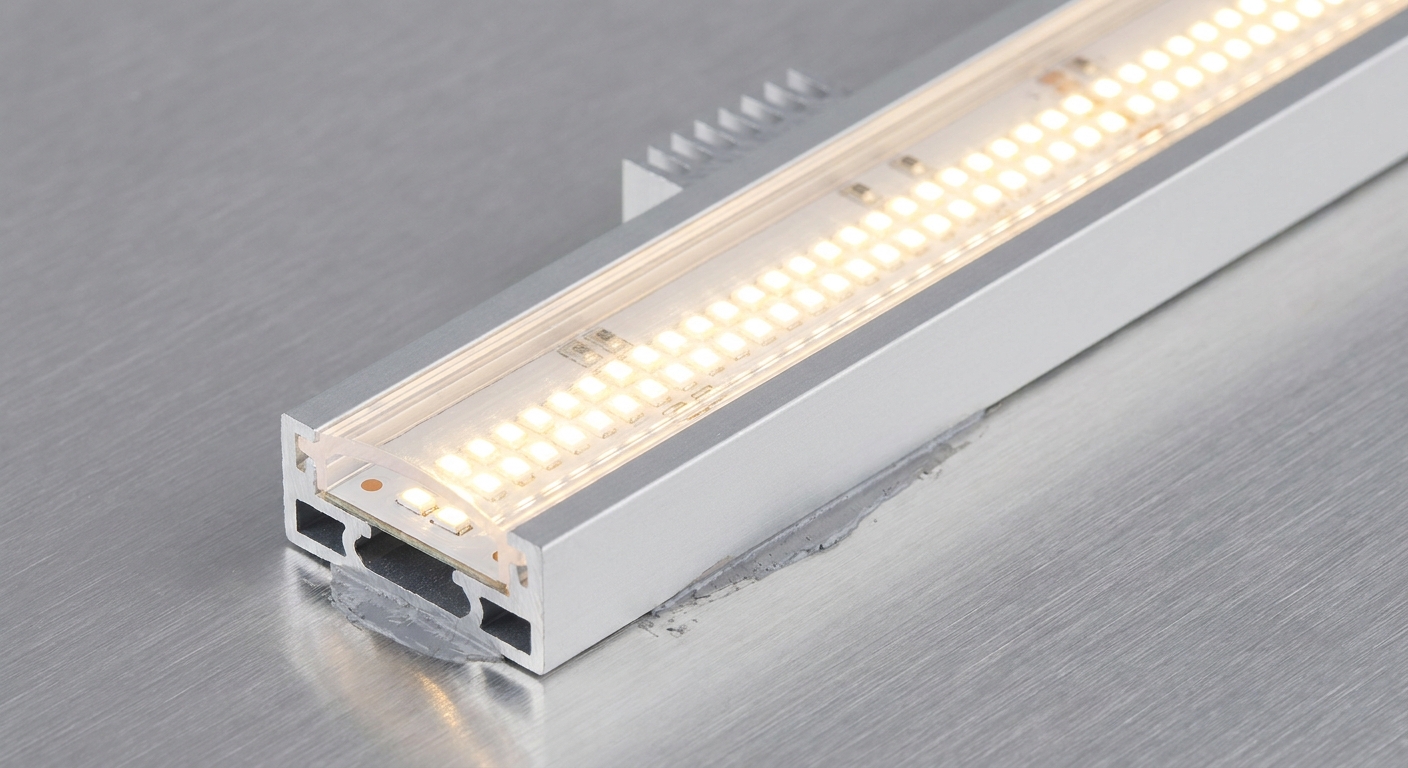
Like all high-performance electronics, a COB LED Strip generates heat, but it is designed with an efficient circuit board that acts as a primary heat spreader. Because the chips are mounted directly to the PCB, the heat moves away from the diodes faster than in traditional LED packages. However, you should always consider the mounting surface to ensure your COB LED Strip operates at its peak efficiency for years to come.
How does the PCB handle heat?
Here is the kicker: the flexible circuit board is actually multi-layered. You will find that high-quality strips use thicker copper traces which help pull heat away from the dense chip clusters. This internal management prevents the phosphor coating from discoloring or the chips from burning out prematurely.
- Dual-layer copper PCB for better thermal conductivity.
- Direct chip-to-substrate contact points.
- Efficient phosphor gel that resists thermal degradation.
When is an aluminum channel required?
But there is more. For strips that consume more than 10 watts per meter, you should always install them inside an aluminum channel. The metal profile acts as a massive radiator, drawing heat away from the PCB and into the surrounding air to protect your investment.
Key Takeaway: Heat is managed through advanced PCB design, but high-power COB strips require aluminum channels for long-term reliability.
| Thermal Factor | Management Strategy |
|---|---|
| High Output (>12W) | Always mount on metal or in aluminum profiles. |
| Continuous Use | Ensure the installation area has some air circulation. |
| Lifespan | Keeping the strip cool can extend its life to 50,000+ hours. |
Using an aluminum channel not only protects the strip from heat but also from dust and physical impact.
What Power Does a COB LED Strip Need?
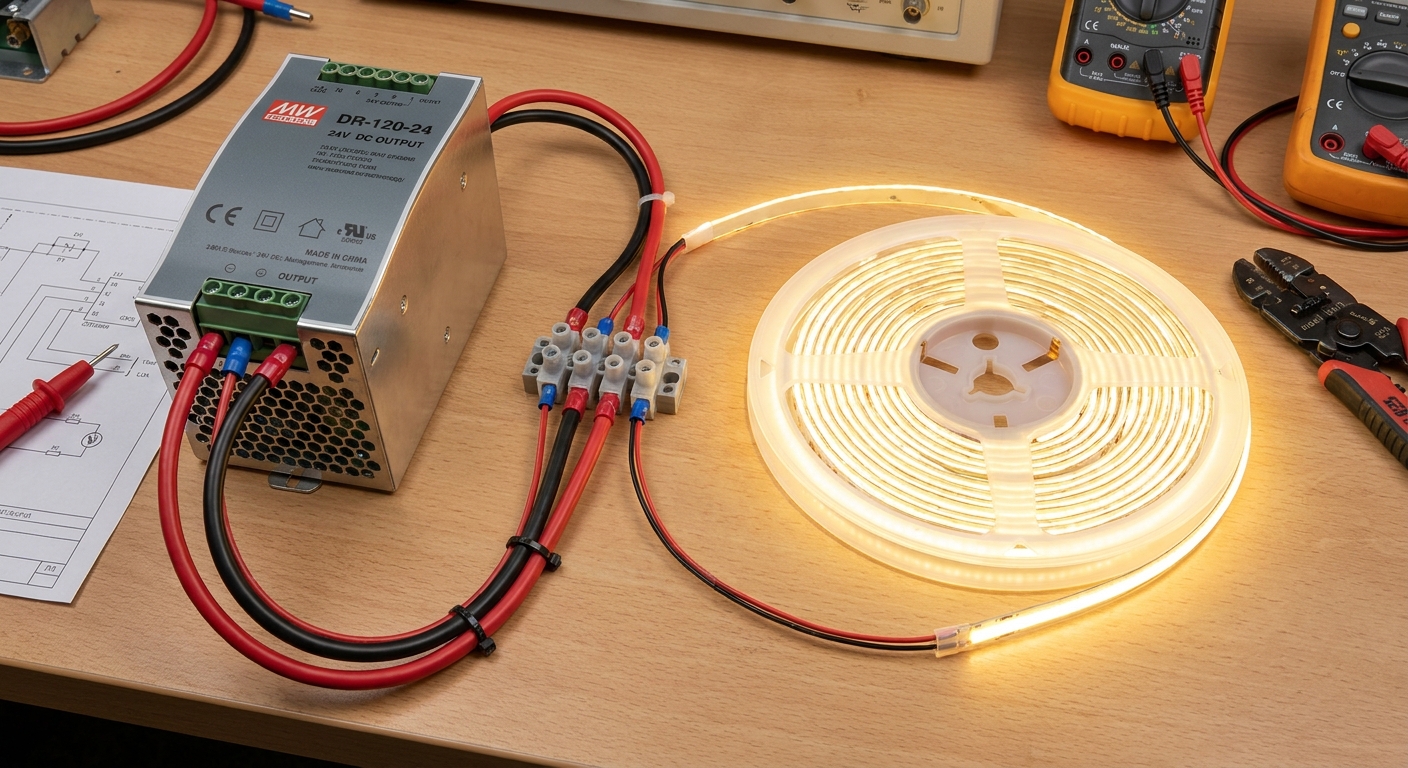
A COB LED strip typically requires a constant voltage DC power supply, usually rated at either 12V or 24V. You must ensure your power source can handle the total wattage of the connected strips plus a 20% safety margin. Selecting the right power architecture is critical for maintaining consistent brightness throughout your COB LED strip installation.
Should you use 12V or 24V?
Think about it: 24V is almost always the better choice for professional projects. You will experience less “voltage drop,” which means the end of a long strip will stay just as bright as the beginning. You should only use 12V for very short runs, such as inside a vehicle or a small display case.
- 12V: Good for runs under 3 meters.
- 24V: Essential for runs over 5 meters.
- Voltage Drop: Higher voltage means more consistent current flow.
How to calculate the total wattage?
But there is more. You simply multiply the wattage per meter by the total length of your run. For example, if you have a 5-meter run of 10W/m strip, you need a power supply that can deliver at least 50 watts, though 60 watts is safer for long-term use.
Key Takeaway: Most professional COB installations utilize 24V DC to minimize voltage drop and ensure perfectly even brightness across long distances.
| Installation Length | Recommended Voltage | Power Supply Margin |
|---|---|---|
| < 2 Meters | 12V or 24V DC | 20% Extra Wattage |
| 2 – 10 Meters | 24V DC | 20% Extra Wattage |
| > 10 Meters | 24V DC (Parallel) | 20% Extra Wattage |
Always check the manufacturer’s data sheet to confirm the exact power draw of your specific strip model.
Can a COB LED Strip Change Colors?
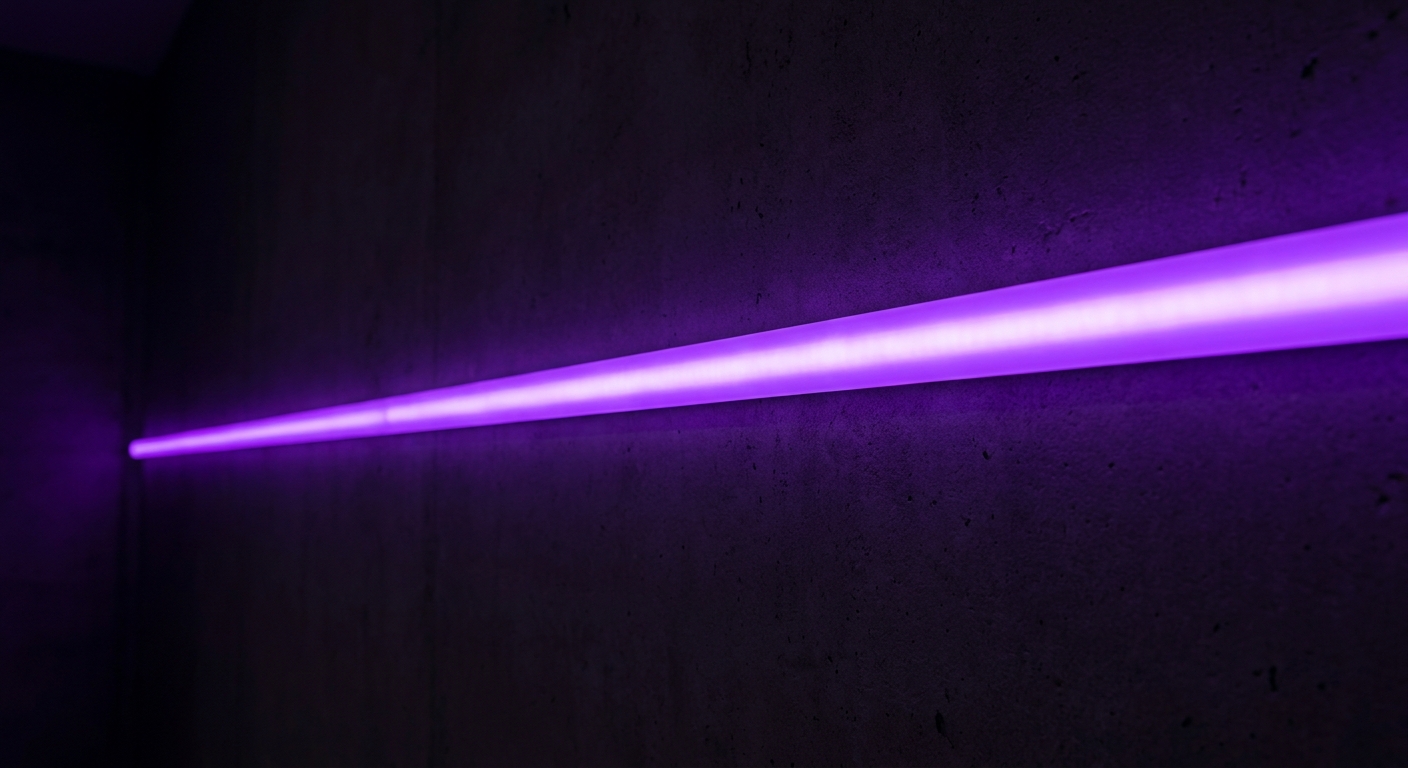
Yes, you can find a COB LED Strip in a wide variety of color options including RGB, RGBW, and tunable white versions. Advanced color-changing models like the Multi Color LED Strip allow you to set the perfect mood for any B2B environment. Because of the dense chip placement, even the color-changing versions of the COB LED Strip remain perfectly dotless and smooth.
Are RGB COB options available?
Here is the kicker: RGB COB strips mix colors better than any other technology. When you select a purple or teal hue, you won’t see individual red, green, and blue dots. You see a single, solid color emitted directly from the phosphor surface, creating a much cleaner effect.
- Red, Green, Blue (RGB) for mood lighting.
- RGB + White (RGBW) for functional white light.
- Seamless color blending within the shared phosphor.
What is a tunable white COB strip?
Think about it: sometimes you want warm light for the evening and cool light for the morning. You can use a W+WW LED Strip to adjust the color temperature from 2700K to 6500K with the press of a button. This is perfect for offices or homes where the lighting needs to adapt to different times of day.
Key Takeaway: COB technology supports full RGB and Tunable White capabilities, offering superior color mixing compared to standard SMD strips.
| Strip Type | Best Used For… | Control Method |
|---|---|---|
| RGB / RGBW | Accents, branding, and dynamic environments. | RGB DC Controller |
| Tunable White | Circadian lighting and multi-purpose rooms. | CCT Dual Controller |
| Single Color | Functional task and architectural lighting. | Dimmer Switch |
Modern controllers allow you to integrate these color-changing strips into smart home or building management systems easily.
How to Install Your COB LED Strip?

Installing your COB LED strip is a straightforward process that begins with preparing a clean, dry surface for the adhesive backing. Most professional strips come with high-quality 3M adhesive that provides a permanent bond to metal, wood, or plastic. By following a logical sequence of steps, you can ensure your COB LED strip looks like it was installed by a master electrician.
How to prepare the surface?
But there is more. You must wipe the area with isopropyl alcohol to remove any oils, dust, or grease. If you skip this step, the adhesive will eventually fail, causing the strip to sag and ruining the visual effect of your lighting.
- Clean the mounting surface thoroughly.
- Wait for the surface to dry completely.
- Test the fit before removing the adhesive liner.
Can you use solderless clips?
Think about it: not every job site allows for hot soldering irons. You can use push-in or clip-style connectors to bridge gaps between cabinets or connect your strip to the power supply. Just make sure you match the number of pins (2-pin for single color, 4-pin for RGB) to the type of strip you are using.
Key Takeaway: Successful installation requires thorough surface cleaning and the use of the correct mechanical connectors for your strip type.
| Installation Step | Success Metric |
|---|---|
| 1. Cleaning | Surface is free of dust and oil residues. |
| 2. Adhering | Strip is pressed firmly without any air bubbles. |
| 3. Wiring | Polarities (+/-) are matched correctly at the source. |
Taking an extra five minutes to clean the surface will save you hours of maintenance work in the future.
Why Buy Your COB LED Strip From Darkless?

Buying your COB LED Strip from Darkless ensures you are receiving a factory-direct product that has been rigorously tested for color consistency and long-term durability. We specialize in helping B2B clients design and manufacture high-performance LED luminaires for global markets. Choosing a professional COB LED Strip from our catalog means you get access to the latest lighting innovations with full technical support.
What are the quality standards?
Here is the kicker: we don’t just sell lights; we engineer them. Our in-house labs test every batch for high CRI (Color Rendering Index) to ensure that the colors in your space look vibrant and true to life. You can trust that our strips will maintain their brightness and color temperature for years, even in demanding commercial environments.
- High CRI (90+) for superior color accuracy.
- Rigorous thermal testing for high-wattage models.
- Consistent binning to avoid color shifts between reels.
Do they offer custom designs?
Think about it: sometimes a standard product isn’t enough for your unique project. You can work with our team to create custom lengths, specialized color temperatures, or unique IP-rated coatings for outdoor use. This level of partnership allows you to expand your market and offer exclusive solutions to your own customers.
Key Takeaway: Darkless provides professional-grade, high-CRI COB strips with the added benefit of custom manufacturing and technical expertise.
| Factor | Darkless Commitment |
|---|---|
| Manufacturing | Direct factory control over every production stage. |
| Reliability | Components certified to CE, RoHS, and FCC standards. |
| Support | Dedicated B2B experts to assist with project design. |
Our focus on quality and customization helps you win more clients by delivering superior lighting results every time.
Frequently Asked Questions (FAQ)
- Can I dim a COB LED strip?
Yes. Most COB strips are fully dimmable when you use a compatible dimmable driver or a low-voltage PWM (Pulse Width Modulation) controller. - What’s the best way to handle corners with COB strips?
The best way is to use small jumper wires or L-shaped solderless connectors. You should avoid forcing the strip into a sharp 90-degree fold as this can crack the internal copper traces. - How do I know if my COB LED strip is waterproof?
Look for the IP rating on the packaging. IP20 is for indoor use only, while IP65 or IP67 ratings mean the strip is protected by a silicone tube or coating for wet environments. - Can I run a 10-meter COB strip from one end?
No. To avoid brightness loss, you should power the strip from both ends or use a parallel wiring setup for any run exceeding 5 meters. - What’s the best color temperature for an office?
The best temperature is typically 4000K to 5000K (Neutral to Cool White). This helps keep employees alert and provides clear visibility for tasks.
Ready to upgrade your next lighting project with seamless, dotless illumination? Our team of experts is dedicated to helping you find the perfect solution for your specific design needs. Please contact us today for a professional consultation or to request a custom quote for your B2B requirements.